Iron Vipers
New Life as a Max Level ArchmageThe Iron Vipers are an adventuring team based in Meridian and distinguished by their specialization in poison. The group is introduced through Miraelle, an accomplished alchemist whose work has advanced her class to Orichalcum rank without making her Titled. Their importance lies less in a single displayed exploit than in the way they connect specialized alchemy, field adventuring, shared resources, and the wider network surrounding Vivisari Vexaria’s return.
Composition and Specialization
The team’s defining characteristic is its poison expertise. Miraelle’s membership makes that specialization a natural extension of her alchemical skill, and the group is described as an ally rather than an unknown or hostile faction. Their work therefore occupies a practical space between laboratory craft and adventuring: the Iron Vipers are not merely scholars who prepare substances in safety, but an active team whose specialty has value in dangerous field operations.
Miraelle’s status gives the group additional weight. She has spent years refining her craft and advancing her class, although with considerably less success than Eshara; she has reached Orichalcum but not the Titled rank. The distinction suggests that the Iron Vipers’ competence is grounded in specialized expertise rather than in the highest publicly recognized status. Their identity is consequently tied to applied knowledge, particularly the controlled use of poison, rather than to ceremonial prestige.
Base in Meridian
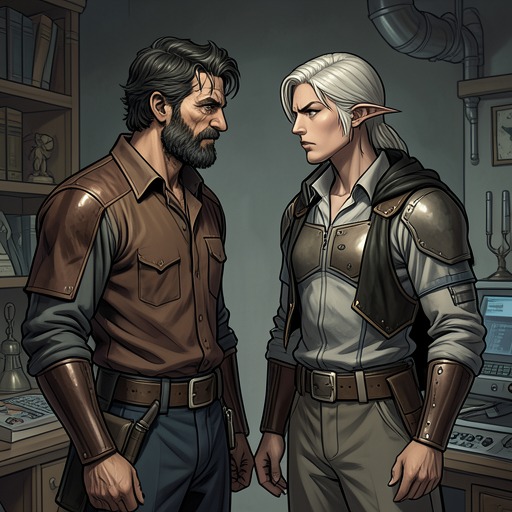
The Iron Vipers possess a guildhall of sorts, although the building is more accurately an alchemy laboratory with living quarters added as an afterthought. The property belongs to Mae, who allows her teammates to stay there when they wish. This arrangement gives the team a communal base without presenting it as a conventional, purpose-built guildhall: work comes first, domestic life is fitted around the laboratory, and membership is expressed through shared access to the space.
The laboratory’s dual function also reflects the team’s character. Its members are adventurers, yet their headquarters is organized around making things rather than displaying military infrastructure or administrative authority. The Iron Vipers’ home is therefore both workshop and refuge, a place where field experience can return to craft and where crafted resources can be distributed back to the team.
Alliances and Resources
The Iron Vipers are counted among Vivisari Vexaria’s allies, although Rafael’s knowledge of them is limited to keeping tabs on their general situation rather than monitoring every movement. Miraelle is away when the team is discussed and is expected to return to Meridian soon; the uncertainty over whether she is on routine adventuring or other business reinforces the group’s mobility and independent activity.
Their resources are also collective. Mae states that the potions she makes go to the team rather than serving her alone, making alchemy a shared economic and tactical foundation for the Iron Vipers. The arrangement contrasts with an individual artisan’s private stock: the group’s work is converted into equipment and support for a coordinated adventuring team. Craft, residence, and field action are consequently bound together through the group’s internal economy.
The Team in the Wider Plot
The Iron Vipers become a lens through which extraordinary events are reported indirectly. After encountering a mysterious woman, a member of the team describes her as dragon-like because she had horns while shifted into demon form and used spells of at least tier fourteen as casually as [Magic Missiles]. He further claims that she disintegrated a level-twelve-hundred opponent and then lifted the Convoy. Mae initially treats the account as exaggeration, but the speaker insists that, for once, he is not overstating what he saw.
This testimony places the Iron Vipers close to the aftermath of a major display of Vivisari Vexaria’s power without making the team the event’s central actor. Their report converts an incomprehensible encounter into rumor, comparison, and professional astonishment. The witness does not identify the woman with certainty; he calls her a dragon and briefly dismisses the matter as something he encountered, while Mae’s questioning exposes how extraordinary the description actually is. The Iron Vipers thus function as observers whose specialized adventurer’s perspective helps establish the scale of Vivisari Vexaria’s return.
Their position is especially revealing against the public mythology of the setting. Prismarche venerates the Party of Heroes because it defeated the seventh and final Cataclysm a century earlier, and the Peace Day Festival celebrates a hundred years of freedom from those disasters. Yet even the legendary Sorceress would not ordinarily be assumed capable of tearing a Cataclysm apart with casual disrespect. After Vivisari Vexaria’s overwhelming intervention, people are more likely to interpret what happened as the appearance of a god than as the return of the Sorceress. The Iron Vipers’ astonished account belongs to this gap between remembered heroism and a power that exceeds the old categories.
Narrative Significance
The Iron Vipers represent a recurring structure in the book: dangerous knowledge circulates through practical communities rather than through a single official institution. Their poison specialization, laboratory headquarters, shared potions, and adventuring activity bind material production to exploration and combat. Through Miraelle, they also remain connected to the advancement of magical classes and to the broader alliance network that Rafael is rebuilding around Vivisari Vexaria.
Their limited direct depiction is itself meaningful. The team is not developed through a formal charter, a roster, or a decisive battle; instead, it emerges through workspaces, offhand reports, uncertain travel plans, and the distribution of potions. That fragmentary presentation makes the Iron Vipers part of the world’s living infrastructure. They are an active but decentralized force, capable of carrying information from remote encounters back into Meridian while maintaining their own craft-centered identity. In that role, they help the narrative measure the extraordinary: when even experienced adventurers and alchemists struggle to describe what they witnessed, Vivisari Vexaria’s power is shown not by abstract ranking alone, but by the failure of ordinary professional language to contain it.